

By Hoery Insurance Agency · With insights and focused factual review from Amelia, Client Success Executive
How do roof payment schedules, replacement cost and actual cash value differ?
- Replacement cost coverage generally pays for covered repairs or replacement with similar materials, without a final deduction for depreciation, subject to the policy's terms.
- Actual cash value subtracts depreciation based on factors such as age and condition. A roof payment schedule uses the payment rules or percentages stated in the policy.
- Check the roof year on your policy. Tell your agency when you replace the roof, even if you paid for it yourself.
After a Colorado hailstorm, “Is my roof covered?” is a fair question. So is, “How much of the bill would I have to pay?”
Those are different questions. Even when storm damage is covered, the way your policy pays for the roof can leave you with more than the deductible.
This guide draws on a conversation with Amelia, Hoery's Client Success Executive. We'll explain roof payment schedules, replacement cost and actual cash value, then show you what to check before your next policy review.
What is a roof payment schedule?
A roof payment schedule is a table or set of rules in an insurance policy that helps determine payment for certain covered roof losses. You may see it called a roof surface payment schedule.
For example, a schedule may assign a payment percentage based on the roof's age and material. The policy spells out which damage and costs the schedule applies to.
“Scheduled” does not mean you're required to replace the roof on a set date. It describes how a covered loss is paid.
The key question is: What part of the roof bill does my policy's schedule apply to, and how much would it pay?
Replacement cost, actual cash value and scheduled payments: what's the difference?
These terms explain how a covered loss is valued. They don't tell you whether every kind of roof damage is covered.
Replacement cost: repairing or replacing with similar materials
Replacement cost value, often shortened to RCV, generally pays to repair or replace covered damage with materials of similar kind and quality. The final covered amount isn't reduced for depreciation, subject to the policy's terms.
You still have a deductible and must meet the policy's limits and conditions. The National Association of Insurance Commissioners explains replacement cost and actual cash value in more detail.
Actual cash value: accounting for depreciation
Actual cash value, or ACV, starts with the replacement cost and subtracts depreciation—a reduction in value based on factors such as age and condition.
For an older roof, that can mean a larger share of the repair bill stays with you. The NAIC's roof claim explanation shows how depreciation and the deductible can affect payment.
Scheduled payment: following the policy's table
A scheduled payment follows the policy's stated rules. An age-and-material table may supply the percentage used for the roof materials it covers.
A roof payment schedule and actual cash value can both leave you paying part of the bill, but they may calculate the payment differently. Check your policy to see which method applies.

| Payment method | Main idea | Question to ask |
|---|---|---|
| Payment methodReplacement cost | Main ideaCovered repair or replacement with similar materials, subject to the policy. | Question to askWhat conditions must I meet to receive the full covered amount? |
| Payment methodActual cash value | Main ideaReplacement cost minus depreciation, based on factors such as age and condition. | Question to askHow would depreciation affect this roof? |
| Payment methodRoof payment schedule | Main ideaPayment follows a stated schedule for the costs it applies to. | Question to askWhich percentage and costs would apply to my roof? |
Your home's insured rebuilding amount is a separate topic. Our guide to replacement cost versus market value for Colorado homeowners explains that distinction.
How much might you pay out of pocket? A simple example
This is a made-up example, not a quote, actual claim or Colorado payment rule.
Assume a covered wind loss requires $12,000 in roof materials, with a $2,000 deductible. For this simplified comparison, there are no other costs, limits or adjustments.
For the ACV example, assume the materials' value after depreciation is $8,000. For the schedule example, assume an invented 65% payment factor applies to these materials.
Explore the made-up example
Why your deductible may not be your whole roof bill.
This is a hypothetical comparison, not an estimate of your claim. Each method below uses the same $12,000 in covered roof materials and a $2,000 deductible.
Replacement cost
$12,000 − $2,000 deductible = $10,000
After applicable replacement-cost conditions are met.
Assumptions for all three examples: covered wind loss; materials only; no labor, other costs, limits or adjustments. ACV is assumed to be $8,000 after depreciation. The 65% schedule factor is invented. Replacement-cost payment is after applicable conditions are met. Actual policy terms can treat costs differently; this comparison does not mean all three methods are available under your policy.
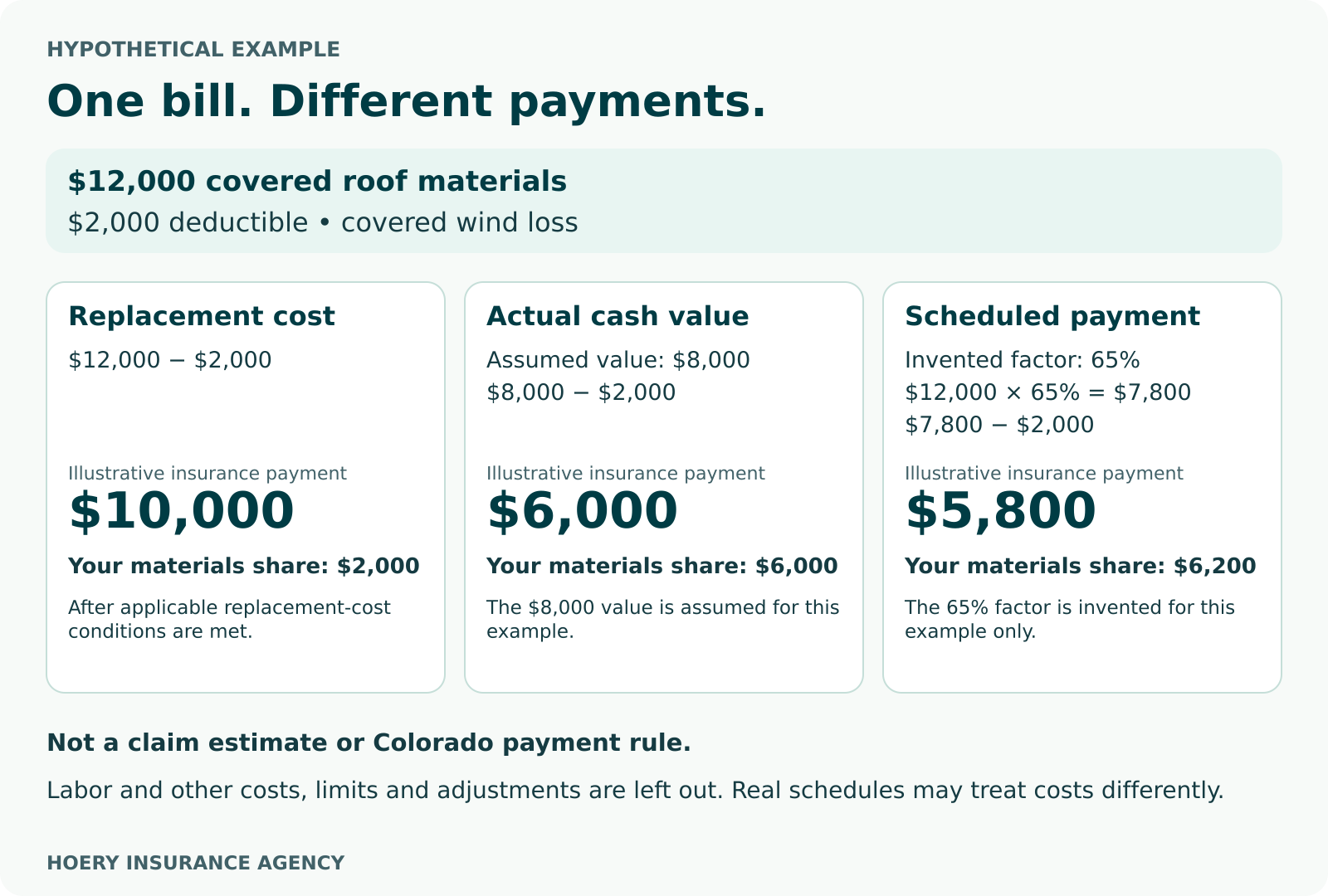
| Method | Calculation | Illustrative insurance payment |
|---|---|---|
| MethodReplacement cost | Calculation$12,000 − $2,000 deductible | Illustrative insurance payment$10,000, after applicable replacement-cost conditions are met |
| MethodActual cash value | Calculation$8,000 − $2,000 deductible | Illustrative insurance payment$6,000 |
| MethodScheduled payment | Calculation$12,000 × 65% = $7,800; then subtract $2,000 | Illustrative insurance payment$5,800 |
Under these assumptions, your share of this materials bill would be $2,000, $6,000 or $6,200.
This isn't a full roof estimate. Labor and other charges are left out, and a real schedule may treat them differently.
Also, the first replacement-cost check may not be the final payment. An insurer may hold back depreciation until repairs are completed and the policy's requirements are met. That later amount is called recoverable depreciation. Ask about the required proof and deadline.
What should you check on your roof coverage?
You don't need to know every insurance term before asking for help. Start with these five checks:
0 of 5 checks prepared. This is preparation, not a rating of your coverage.
Keep the cause of damage separate from the payment method, too. A homeowners policy generally doesn't pay to replace a roof simply because it has worn out. The NAIC's consumer guide explains the difference between insurance and home upkeep.
Should you tell your agency after replacing your roof?
Once the work is done, it's easy to file the invoice away and move on. Add one more step: let your insurance agency know, even if you didn't file a claim.
Have these ready:
- The date the work was completed.
- The completed-work invoice.
- The roof material and any other installation details you have.
At Hoery, we can confirm the update steps for your policy and arrange any required form for you to sign. If a document is missing, ask us what else may work.
A new roof doesn't automatically change your payment terms or guarantee a lower price. Ask the agency to confirm any changes and when they take effect. Keep the updated policy documents with your roof records.
Common roof insurance questions
Will insurance cover a 20-year-old roof?
Age alone doesn't answer that question. The cause of damage, policy terms and roof condition matter. Don't assume an older roof has no coverage, or that any roof damage means a full replacement will be paid.
How can I tell which roof payment terms I have?
Look for roof wording in your declarations, the policy summary, and in any endorsements. If you can't find a clear answer, ask your agent to point to the wording and walk through an example.
Do all Colorado roofs move to scheduled payments at the same age?
No single age should be assumed for every Colorado policy. The rules can vary by policy, roof material and other requirements. Check your own terms rather than applying a friend's experience to your home.
Know your roof's terms before you need them
You now know why “covered” and “paid in full” aren't the same thing. Your next step is to check the roof year on file and how your policy would pay for covered roof damage.
Not sure where to look? Send Hoery your question. We'll help you understand which wording to review and what information to have ready.
This guide provides general education. Coverage and claim payments depend on the actual policy and facts of the loss.
Hoery Insurance Agency · Personal Lines / Home
What should you ask about your roof coverage?
These questions help prepare a conversation. They do not determine coverage or a claim payment. Actual policy terms and facts of the loss apply.
 Replacement Cost vs. Market Value: What’s the Difference?
Don’t forget to share this article
The next step is easy, call us at 303-220-7688, or click below to start your insurance quote
Related Articles

What’s the difference between replacement cost and market value? Learn how Colorado homeowners can compare rebuild estimates with dwelling coverage.
7.9 min read/Obviously, you want to protect your home against burglary year-round. But thieves know your home will likely ...
2.8 min read/Life doesn’t stop after you obtain insurance coverage. Maybe you added that much-needed extra bathroom to your ...
4.4 min read/


